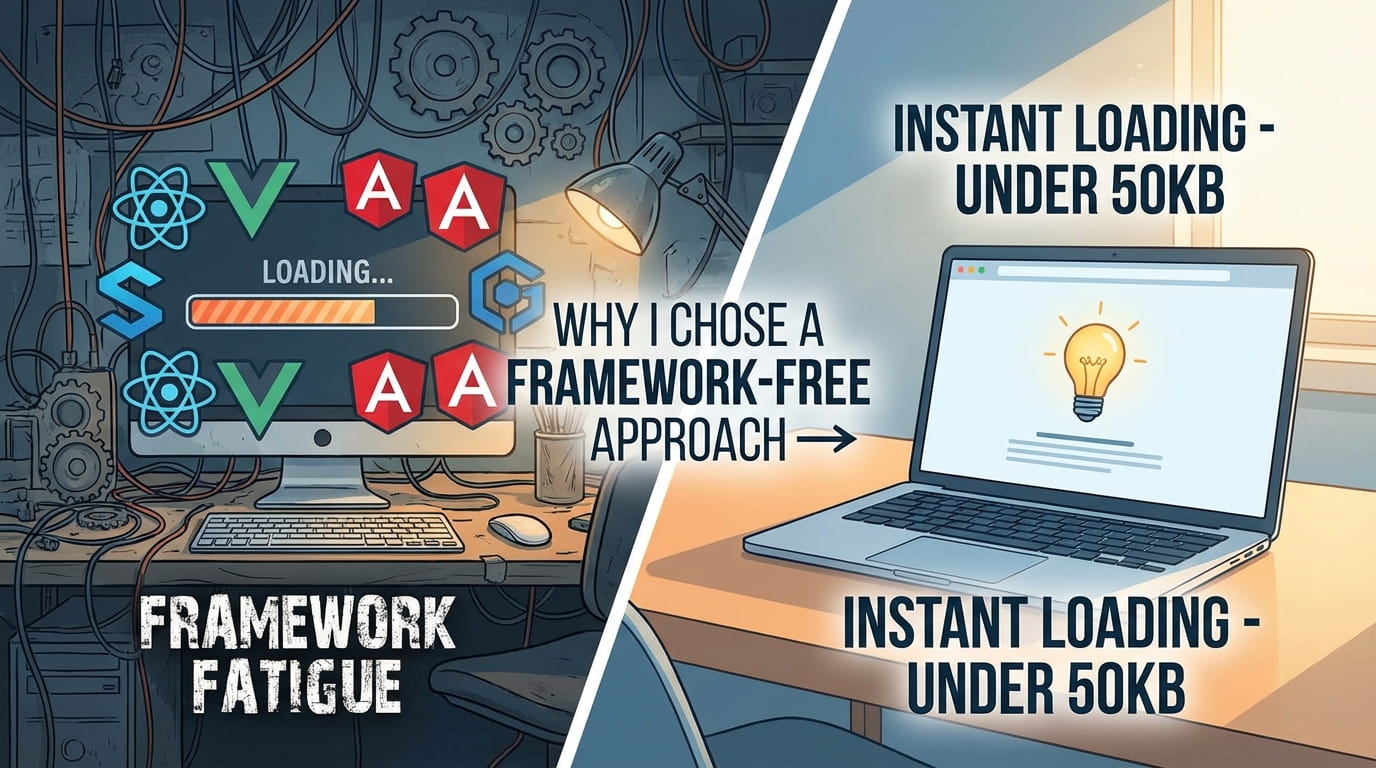
After years of working with various JavaScript frameworks, I decided to build my personal site without any of them. Here's why.
The Framework Fatigue is Real
Don't get me wrong - I love NodeJS, Deno, Fresh, Astro and other frameworks. They're incredibly powerful tools for building complex applications. But for a personal blog and portfolio? It felt like overkill.
The Problems I Wanted to Avoid
- Build complexity - webpack configs, transpilation, bundling
- Dependencies - npm install taking minutes, security alerts
- Breaking changes - updating major versions, migration guides
- Over-engineering - Do I really need a virtual DOM for blog posts?
What I Gained
By going framework-free, I got:
1. Instant Loading
No JavaScript bundle to download and parse. The browser can render everything immediately. My entire site is under 50KB including CSS.
2. Zero Dependencies (Almost)
For local development, I only need:
marked- to convert Markdown to HTMLgray-matter- to parse frontmatter
That's it. No build tools, no transpilers, no bundlers.
3. Longevity
This site will work exactly the same in 10 years. No framework updates, no breaking changes, no deprecation warnings.
4. Learning Experience
Working directly with the web platform taught me:
- Modern CSS features I didn't know existed
- Native Web APIs that replaced libraries
- How much browsers can do out of the box
Modern CSS is Incredibly Powerful
Here are features that replaced what I'd usually reach for JavaScript:
/* Dark mode without JavaScript */
@media (prefers-color-scheme: dark) {
  :root {
    --color-bg: #0f172a;
  }
}

/* Responsive without media queries */
.grid {
  display: grid;
  grid-template-columns: repeat(auto-fit, minmax(300px, 1fr));
}

/* Fluid typography */
h1 {
  font-size: clamp(2rem, 5vw, 4rem);
}
When Frameworks Make Sense
I still use frameworks professionally! They're perfect for:
- Complex interactive applications
- Real-time collaboration tools
- Large teams with shared component libraries
- Projects requiring rich interactivity
But for content-focused sites like blogs and documentation, plain HTML/CSS often works better.
The Middle Ground
You don't have to choose all-or-nothing. You can:
- Start with static HTML/CSS
- Add sprinkles of JavaScript where needed
- Use Web Components for reusable elements
- Progressively enhance as requirements grow
Conclusion
Building without a framework forced me to really understand the web platform. It reminded me that simple solutions are often the best solutions.
The web is already pretty great on its own. Sometimes we just need to get out of its way.
What's your take? Do you prefer frameworks or vanilla approaches? Let me know on Twitter!